
By Ollie Mintz
•
Republicans lost both chambers of Congress, five governorships and seven state legislative chambers on Tuesday night. The only Republican in the country who ended the week stronger than he started it was a term-limited governor from Florida with no office left to run for, who spent election night telling anyone who would listen exactly why his party was about to lose, and spent the morning after telling them it could last a decade.
The Diagnosis and the Alibi
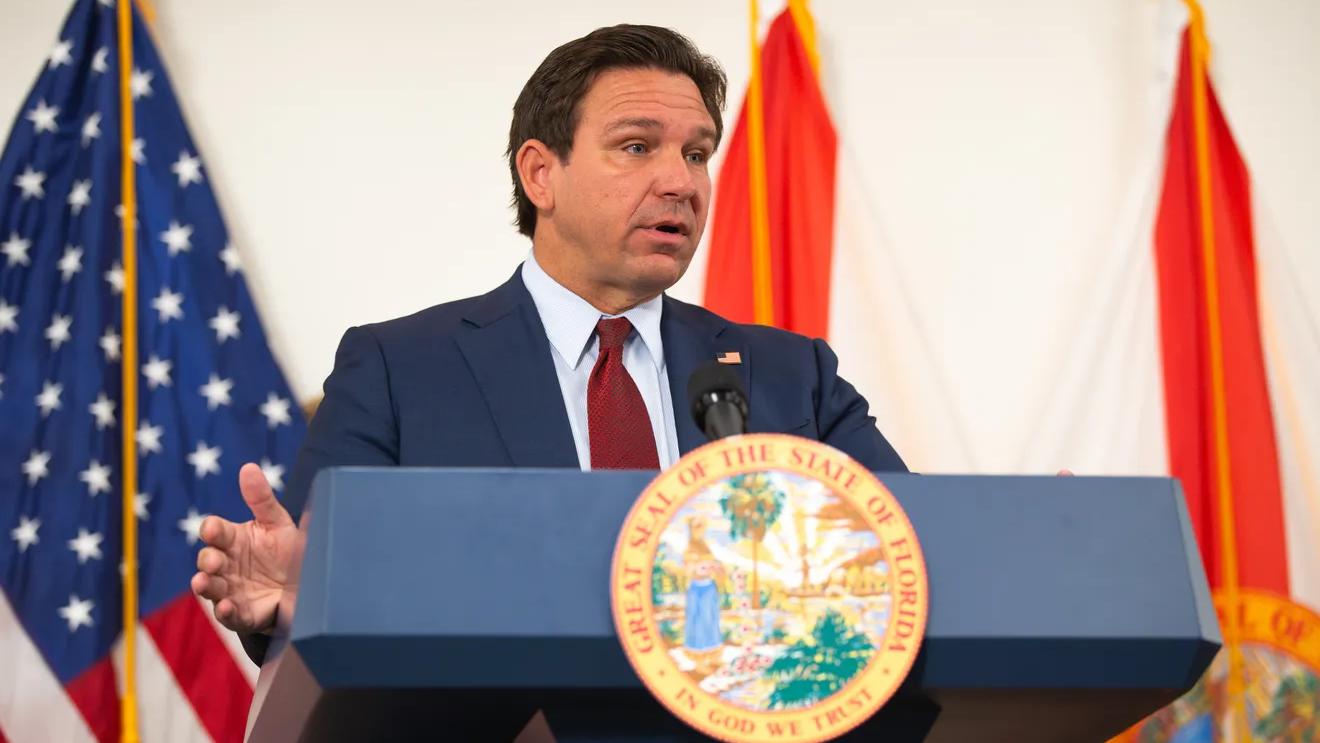
Ron DeSantis walked into a press conference in Tallahassee on Wednesday morning and told his own party it might be dying. What happened Tuesday, he said, was close to an extinction-level event for Republicans in many parts of the country, as bad as anything in the last hundred years. He did not appear on a single ballot in America this week. He finished it as the most improved Republican in the United States.
He declined to call it a wave. A wave, he said, was not fully accurate for what had happened, and he reached instead for the political equivalent of a meteor strike, one that hit blue states and red states and everything in between. The numbers support the imagery. Democrats took both chambers, flipped seven Senate seats including Texas and Kansas and South Carolina, picked up five governorships and seven state legislative chambers. DeSantis went further than most Republicans were willing to go on Wednesday, warning that his party will not be able to retake the Senate in 2028 under the current map, and noting that of the ten largest states in the country, only Florida will have Republican control when new officials are sworn in come January.
None of this was improvised Wednesday morning. He had already said the hard part the night before, while the returns were still coming in, in an interview on Stephen A. Smith's podcast. The war with Iran was a big, big drag on Republican candidates. Gas was higher because of the war and working people were paying for it. A party that refuses to admit that is gaslighting its own voters, and once you have done that they stop listening to you about anything else. Democrats were energized and Republicans were not. Pundits on the BBC's Americast heard all this and said he had fired the starting gun on 2028. They were right, and he fired it before the body was cold.
Now compare the other performance. Trump posted that he had not been on the ballot and would have won in a landslide if he had, which is a difficult position to hold after six weeks of telling crowds to pretend he was. He called Greg Abbott a RINO on the way down. He blamed candidate quality, said his base did not like the people he endorsed, accepted the results, and promised to govern by veto. By Wednesday, he had no public events scheduled. One of these men spent the week explaining a loss. The other spent it diagnosing one, which is a different activity with a different audience.
The timing was not luck. DeSantis is term-limited and out of office in January. He is 48. He spent all of 2023 trying to beat Trump without criticizing Trump, finished a distant second in Iowa and quit before New Hampshire, which is the most expensive political lesson any Republican of his generation has paid for. He was never going to pay for it twice. He had a theory about why this night would go badly, he said it on the record before the results could make him look like he was piling on, and then the results arrived and proved him right in forty states.
That is what winning an election you are not in looks like. Three things happened to DeSantis on Tuesday without him spending a dollar. The Republican bench that would have crowded him out in 2028 was substantially destroyed, the one state that held was his, and the only rival who starts ahead of him got handcuffed to the record that just cost the party the country.
Everyone Who Would've Crowded Him Out
A presidential primary is a competition for a finite amount of oxygen, and on Tuesday night a great deal of the competition stopped breathing. The Republicans who lost were not a random cross-section of the party. They were disproportionately the ones who had built a national profile out of proximity to Trump, which is to say they were the people who would have been standing on a debate stage in Iowa in 18 months.
Ken Paxton, who beat a sitting senator in a primary and then lost Texas to a 37 year-old state representative. Michael Whatley, the former Republican National Committee chairman, recruited into the North Carolina race by the president himself, beaten by Roy Cooper. Vivek Ramaswamy, who ran the most nationalized gubernatorial campaign in the country and lost Ohio to Amy Acton. Mike Collins, beaten by Jon Ossoff in Georgia. Ashley Hinson in Iowa, Jon Husted in Ohio, Roger Marshall in Kansas, Darline Graham in South Carolina. And Greg Abbott, three terms a governor of the largest Republican state in the union, who lost and was then called a RINO by the president before the night was over.
Look specifically at the governor's lane, because that is where Republican presidential candidates come from. Abbott is gone. Ohio went to a Democrat. Iowa, Georgia, Arizona, Michigan and Nevada either flipped or stayed blue. The party lost five governorships and seven legislative chambers on a single night. Whatever the Republican field looks like in 2028, it will not be built out of sitting governors, because most of the states that would have produced them just elected Democrats. The exception, and it is the only one that matters here, is Florida.
The Movement Without the Man
Listen to how DeSantis framed the next cycle and you can hear the stump speech assembling itself in real time. He asked whether 2028 will be a continuation election, where voters want effectively another term of Trump, or a change election. If it is a change election, he said, the public wants change and Republicans can offer it. Then he described the pitch almost literally: take the successes Trump had, build off them, and then do several other things differently. That is a man test-driving a general election message 18 months before the first primary debate. Keep the policy. Lose the chaos, lose the war, lose the four-dollar gas.
Wednesday in Tallahassee he started filling in the blanks. He said the election was a rejection of Republicans in Washington rather than an embrace of Democrats, which is the most useful sentence available to a Republican who wants to inherit the voters without inheriting the record. Then he listed grievances that have nothing to do with the culture war he spent eight years prosecuting. Congressional stock trading, which he said Republicans should ban outright. The handling of the Epstein files. Affordability. Government transparency. And a set of technology and privacy concerns, from AI surveillance to license plate camera networks to data centers, that he warned Republicans were dismissing at their peril. That is not a governor venting. That is a man reading the exit polls and building a platform out of the places his party is exposed.
He is the only Republican who can make that argument with a state behind him, because Florida was the exception to Tuesday night. Byron Donalds won the governorship and will be the first Black governor in Florida history and the first Black Republican elected governor anywhere in the country. Ashley Moody held her Senate seat against Angie Nixon, a democratic socialist who had won an upset primary. Most of the congressional map held, including seats the legislature had redrawn to be more Republican. While Kansas, South Carolina, and Texas were falling, Florida stayed exactly where DeSantis left it.
The Donalds result is the part worth sitting with, because it did not happen the way the president intended. Trump endorsed Donalds in early 2025, long before anyone else had moved, and it was read at the time as retribution. It cleared the field for a congressman who had endorsed Trump over DeSantis in the 2024 primary, and it boxed out Casey DeSantis, who was seriously considering the race. DeSantis spent a year refusing to play along. He questioned Donalds' record in public, said the congressman had not been part of Florida Republicans' victories, declined to endorse in the open primary, and came around only on September 1, when he backed the entire slate at a Tampa forum.
And then Donalds closed the campaign running on DeSantis anyway. Much of his late messaging leaned on the DeSantis endorsement and a promise to continue the legacy, for the straightforward reason that DeSantis's approval rating in Florida runs ahead of Trump's. His line on stage in Tampa was that his mission as governor would be to build on the success of Ron DeSantis. David Jolly, the Democrat, spent part of the fall selectively praising DeSantis too, at one point telling Floridians during a hurricane to follow the current governor's directions. Trump picked the nominee. DeSantis owned the brand the nominee chose to run on. When both candidates in a governor's race are campaigning on your record, the state is yours no matter whose endorsement cleared the primary.
The honest discount is that Jolly was outmatched from the start and could not get much help from national Democratic groups, which have largely written Florida off over several cycles. Some of Tuesday's margin there is structural, built over a decade of registration advantage and aggressive mapmaking that had nothing to do with persuasion. DeSantis himself conceded Wednesday that the margins were narrower than Florida Republicans are used to, and said he had spent months warning that Donalds and Moody could face close races despite the registration edge. He credited Amendment 3, the property tax measure, with holding the line. But structure is his argument too. He spent 8 years building the machine, and on the night the national party lost Kansas and Texas, the machine held.
The markets moved before the sun came up. On the trading platform Kalshi, JD Vance's odds of winning the 2028 Republican nomination fell from 35 percent Tuesday to 27 percent Wednesday, while DeSantis more than tripled, from 5 percent to 17. On the presidency itself Vance dropped from 19 to 12 and DeSantis climbed from under 3 to 6. These are play-money numbers and they will move again by Christmas. What they measure is not who wins. It is how fast Republican money started looking for an exit.
And that is the structural reason DeSantis moved first. The 2028 primary is going to be an argument about blame, and Vance cannot participate in it. He is the sitting vice president of the administration that prosecuted the war and presided over the prices. Every attack on the record is an attack on his own resume. Donald Trump Jr. cannot make it. Marco Rubio cannot make it from inside the cabinet. Whoever wants to run as the correction has to be outside the building, and as of January, DeSantis is the most credentialed Republican in America who is standing outside the building.
The case against him is not small, and anyone writing him a coronation is not paying attention. He has run once and been humiliated by the man he is now positioning against. He is a famously poor retail politician who spent 2024 being out-charmed by Nikki Haley. His odds still sit ten points behind Vance's. Asked directly in Tallahassee whether Republicans should be looking to him to rescue the party, he turned the suggestion down, which is either genuine or the oldest move in the book. And the central bet is the shakiest part of all: DeSantis is wagering that Republican primary voters will punish Trump for an election Trump was not on the ballot for, which is the one thing those voters have generally refused to do. But he is first. In a fight over who gets blamed, first is not nothing.
What Can Still Hurt Him
The thing that makes DeSantis's bet rational is that the coalition which beat his party on Tuesday is not an ideological coalition and cannot be counted on to stay assembled. Abdul El-Sayed won Michigan running well to the left of his own party. Adam Hamilton won Kansas by promising to be an independent-minded Democrat who believes in a strong border and whose best friend in the Senate will be a Republican. Angie Nixon, a democratic socialist, lost Florida comfortably. Troy Jackson is a logger, Josh Turek is a Paralympian, Rob Sand is a former state auditor. There is no lane here. There is a mood, and the mood is that things cost too much and nobody in charge seems to care.
Moods are rentable, not ownable, and nothing about Tuesday says otherwise. Kansas and South Carolina did not convert. They registered a complaint about prices and a war, through whichever candidate happened to be standing there. Those results are loans, and they come due in 24 months, in a divided government where the president has already announced he will govern by veto. If Democrats cannot produce something material on cost of living against a veto pen, then 2028 arrives as exactly the election DeSantis described on that podcast: a change election, in which the public wants change and the only question is who is credible in offering it.
What can still hurt him is the man he is maneuvering around, and the distinction he is betting on is a fine one. Voters did punish Trump this week, and a meaningful share of them came from his own party. His approval sat at 38 percent. Non-MAGA Republicans told exit pollsters he was not a factor in their vote, a sharp break from 2018, when most Republican voters said their ballot was cast to support him. Adam Hamilton could not have taken Kansas without a substantial number of Republicans crossing over to him. Trump's own explanation, that his base did not care for the candidates and that some of the people he endorsed had fought him, concedes the point in the act of denying it. And in Iowa, his preferred candidate for governor, Randy Feenstra, lost the Republican primary outright, which is primary voters declining to follow him in a closed contest.
But a general election is not a nomination fight, and that is the gap DeSantis has to clear. Trump still has two years, a megaphone, and a primary electorate that has rarely chosen against him when he has engaged a race directly. The last person to test it was DeSantis himself, in 2024, and he finished a distant second in Iowa and quit before New Hampshire. Trump can anoint Vance. He can spend 2027 reminding Republican voters that DeSantis knifed him on a podcast the night the party lost the country, a story that writes itself and has worked before. DeSantis needs the war to stay salient enough that voters still blame it in 2028 and resolved enough that it stops being a loyalty test. That is a narrow window, and he controls neither side of it.
None of which changes the arithmetic of Tuesday. Every Republican with a plausible 2028 claim got weaker on election night except one, and the one got stronger by saying something true into a microphone at the moment it was most expensive to say it. Ron DeSantis spent election night building a campaign while the president spent it building an alibi. The returns came in and only one of them was still standing where he had chosen to stand. That is what a winner looks like in a year nobody won.