
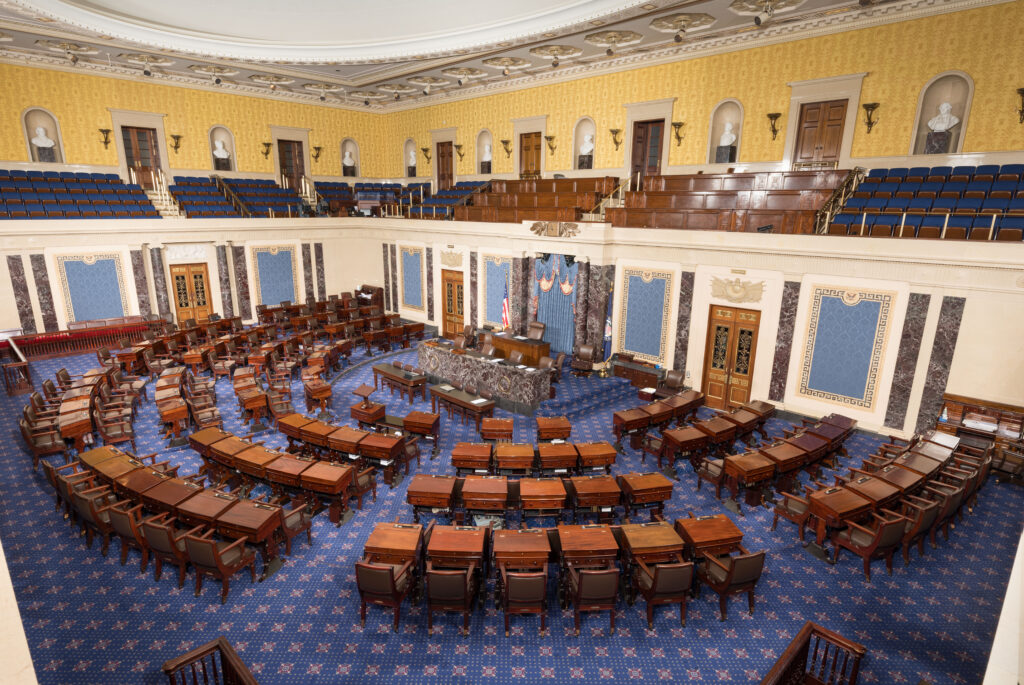
I expect Democrats to make substantial gains without taking control, Republicans to win Michigan, and five additional states to send senators from opposing parties to Washington.
On November 4, Americans will begin sorting through results that leave some candidates celebrating, others wondering what went wrong, and political analysts explaining why voters did not behave quite as expected.
I might be among those analysts, with a considerable amount of egg on my face.
That is the risk of making predictions before the votes are counted. Pollsters have their models, campaigns have their internal numbers, and pundits have an extraordinary ability to explain precisely why something happened after it has already happened.
Nevertheless, I am making a few calls.
I predict the next United States Senate will be divided 50–50, leaving Republicans with the organizational advantage of Vice President JD Vance’s tie-breaking vote. Democrats will make substantial gains, but a Republican pickup in Michigan will keep them one seat short of an outright majority.
The more interesting prediction is geographical: I expect the number of states represented by senators with different party affiliations to rise from four to nine.
That would not mean polarization has disappeared. It would suggest that, in some consequential races, voters remain willing to make an exception.
Whatever Happened to the Split Delegation?
When the 119th Congress convened in January 2025, only four states had senators with different party affiliations: Maine, Pennsylvania, Vermont and Wisconsin. According to the University of Minnesota’s Smart Politics analysis, that was the lowest number in the direct-election era.
Compare that with 1979, when 27 states had split delegations. In 2011, there were 19. By 2015, the number had fallen to 15.
One qualification matters. Vermont’s Bernie Sanders is an independent who caucuses with Democrats. Counting delegations divided between opposing Senate caucuses produces a starting number of three, rather than four.
Another qualification is equally important: a split delegation does not automatically demonstrate split-ticket voting. Senators serve staggered terms. Voters may elect one during a Republican wave and another in a very different political environment.
Even so, the decline tells us how unusual it has become for a state to sustain senators with different party identities.
My forecast would create five additional split delegations while preserving the existing four.
Here is where I think voters will make those exceptions.
Kansas: The Biggest Exception
My prediction: Adam Hamilton defeats Roger Marshall.
Kansas is among my hardest calls to justify through conventional partisan arithmetic. The state has not elected a Democratic senator since 1932. Hamilton is asking voters to do something Kansas has avoided for almost a century.
What interests me is his appeal beyond the Democratic base. His candidacy has attracted Republican crossover support, including former Gov. Bill Graves.
The September debate at the Kansas State Fair also caught my attention. Marshall faced a frequently hostile audience, while Hamilton appeared comfortable presenting his argument. Reporting documented the heckling and the crowd’s strong support for Hamilton.
A debate audience is not a representative sample of Kansas voters. It cannot tell us how the state will vote.
But watching candidates respond under pressure offers information that a polling margin does not. Hamilton made his case on agriculture, immigration and the administration’s record in a setting where the differences between the candidates were difficult to miss.
Marshall has incumbency and a Republican electorate. Those are substantial advantages.
My prediction is that Hamilton’s personal appeal reaches far enough beyond his party to overcome them. Kansas sends senators from different parties to Washington.
Michigan: The Polls, the Progressives and the Muslim Brotherhood Controversy
My prediction: Mike Rogers defeats Abdul El-Sayed.
Michigan is where I am most skeptical that progressive enthusiasm will translate into a winning general-election coalition.
El-Sayed won the Democratic primary by roughly one percentage point after polls showed him leading by as much as 15 to 19 points. Pollster Adam Carlson, whose firm produced the 19-point estimate, later pointed to differential nonresponse, with El-Sayed supporters more willing to participate in surveys than supporters of his primary opponent, Haley Stevens.
That doesn't mean November's polls will suffer the same error, but it raises questions about whether his enthusiastic progressive base represents the broader Michigan electorate.
El-Sayed has attracted support from democratic socialists and embraces policies including Medicare for All and abolishing Immigration and Customs Enforcement. His challenge is maintaining that enthusiasm while persuading moderates, independents and Democrats who preferred another nominee.
Complicating matters is the controversy surrounding alleged family ties to the Muslim Brotherhood.
Republicans, including Rogers and Trump, have raised questions following the resurfacing of social-media posts by El-Sayed's half-sister describing longstanding family connections to the movement. His biological mother also previously worked for the Islamic American Relief Agency, which the Treasury Department designated in 2004 for supporting terrorism. She was not charged with a crime, and that organization is distinct from the Muslim Brotherhood. None of the available evidence establishes El-Sayed's personal involvement with either organization.
The controversy came to a head at an October 17 town hall. Asked directly whether he would disavow the Brotherhood, El-Sayed answered affirmatively before turning the exchange into a confrontation with the questioner, challenging his motives and invoking John F. Kennedy's experience with anti-Catholic prejudice.
Having watched the exchange, I found his handling of it more confrontational than reassuring. He verbally disavowed the organization, but spent considerably more time challenging the questioner than addressing the family-history allegations. Supporters saw a defense against religious prejudice; critics saw an opportunity to address legitimate questions left largely unanswered.
Whether that controversy ultimately helps or hurts El-Sayed remains uncertain. But it adds another dimension to a campaign already struggling to reconcile progressive enthusiasm with the demands of a closely divided electorate.
Rogers has challenges of his own. He lost Michigan's 2024 Senate race even as Trump carried the state, demonstrating that Republican presidential support doesn't automatically translate into Republican Senate votes.
But that result also demonstrates something central to my broader prediction: Michigan voters are willing to evaluate candidates independently of their parties.
I'm calling Rogers.
Texas: The Votes Paxton Does Not Receive
My prediction: James Talarico defeats Ken Paxton.
My Texas call rests partly on Talarico’s appeal and partly on the Republican nominee.
Paxton retains substantial support. He also carries political liabilities that cannot be dismissed as Democratic inventions. In 2023, the Republican-controlled Texas House voted 121–23 to impeach him. The Senate subsequently acquitted him on the articles it tried. Both facts belong in a fair account.ballotpedia+1
I think enough Republican-leaning voters will distinguish between supporting their party and supporting this particular nominee.
Some may vote for Talarico. Others may leave the contest blank or choose Libertarian Ted Brown.
I know a handful of people who have described those latter choices to me. Those conversations are anecdotes, not evidence of a statewide trend. But they illustrate the mechanism I am watching.
Relative to otherwise voting for Paxton, switching to Talarico changes the margin between them by two votes. Voting for another candidate or skipping the contest changes it by one.
Talarico therefore does not need every dissatisfied Republican to embrace his policies. He needs to build his own coalition while enough Republican-leaning voters withhold support from Paxton.
That would not make Texas a Democratic state. It would make this an election in which the candidate mattered.
I believe enough voters will make that distinction for Talarico to win.
North Carolina: An Established Coalition
My prediction: Roy Cooper defeats Michael Whatley.
Cooper has an advantage that cannot be manufactured during a single Senate campaign: North Carolinians have already elected him statewide and watched him govern.
Whatley brings substantial party experience. Cooper brings an electoral record voters have repeatedly evaluated. Cook’s October 6 move to Likely Democratic reinforces the case that this contest has become unusually favorable for Democrats.
No election is predetermined. But this is a race where candidate history and the broader assessments point in the same direction.
I expect Cooper to win, creating a split delegation alongside Republican Ted Budd.
Ohio: A Republican Hold, Narrowly
My prediction: Jon Husted defeats Sherrod Brown.
Brown has a recognizable political identity beyond the national Democratic Party. His long relationship with Ohio voters gives him a route that a less familiar Democrat might struggle to find.
But familiarity is not a winning coalition by itself. Brown lost in 2024, and Husted brings an extensive statewide career of his own.
The polling provides reasons for caution. A Bowling Green State University/YouGov survey released October 16 showed Brown ahead by six points. Rasmussen’s October 19 release put Husted ahead by two. These are different surveys, not proof that the electorate moved eight points between them.
My judgment is that Ohio’s Republican advantage ultimately matters more than Brown’s remaining crossover appeal.
Husted does not need voters to reject everything they once liked about Brown. He needs enough Republican-leaning voters to prefer keeping the seat in Republican hands.
Brown can win. I am predicting that Husted does.
Alaska: A Different Electoral Calculation
My prediction: Mary Peltola defeats Dan Sullivan.
Peltola has demonstrated that she can win statewide in Alaska. Sullivan has incumbency and the advantages of running as a Republican in a state that favors Republican presidential candidates.
Neither fact settles the contest.
Ranked-choice voting makes subsequent preferences important if no candidate wins an initial majority. Another candidate named Dan Sullivan also appears on the ballot, adding an unusual complication—though name confusion should not be assigned a measurable effect without evidence.
I expect Peltola’s appeal beyond the Democratic base to carry her through.
I would not assume we will know the final answer when much of the country wakes up on November 4.
Maine: I Am Not Counting Collins Out
My prediction: Susan Collins defeats Troy Jackson.
Collins has spent decades persuading Maine voters to distinguish between her and the national Republican Party.
In 2020, polls suggested she was in serious danger. She won while Joe Biden carried the state. That crossover coalition appeared in the results, not simply her campaign’s argument.
Now she has another advocate for making that distinction: former West Virginia Sen. Joe Manchin, who served as a Democrat before becoming an independent.
Manchin is scheduled to campaign with Collins in the Lewiston–Auburn area on October 21. He told Semafor that his visit is intended to counter the argument that she has enabled Trump, pointing instead to their work on infrastructure and the Electoral Count Act. “She is not a Trump senator,” he said.
Manchin cannot transfer his reputation to Collins by appearing beside her. His support does, however, give voters a former Democratic colleague making the case that her bipartisan record is more than campaign branding.
Jackson has a different argument: whatever voters think of Collins personally, her reelection helps determine which party controls the Senate.
That is the choice. Collins wants voters to judge her individual record. Jackson wants them to consider the consequences of returning a Republican to Washington. Those considerations are different, but neither is irrelevant.
I expect enough Mainers to preserve their exception for Collins. Manchin’s visit does not prove that prediction correct. It shows how deliberately her campaign is working to make it happen.
The Holds I Am Calling
My remaining predictions are:
Iowa — Ashley Hinson, Republican.
Minnesota — Peggy Flanagan, Democratic.
Nebraska — Pete Ricketts, Republican.
South Carolina — Darline Graham, Republican.
Georgia — Jon Ossoff, Democratic.
New Hampshire — Chris Pappas, Democratic.
Florida — Ashley Moody, Republican.
Two contests deserve particular attention.
Nebraska independent Dan Osborn offers another test of whether a candidate outside the Democratic label can attract voters who would reject a conventional Democratic nominee. I expect Ricketts to win, but Osborn’s coalition is worth examining.
In South Carolina, Darline Graham entered the Senate by appointment after her brother Lindsey Graham’s death. That gave her incumbency, but appointment and an independently demonstrated general-election coalition are different things.
I have heard concerns from people active in South Carolina Republican politics about the nomination process and turnout. Those conversations help explain why I am watching the race. They do not establish the views of the entire party.
I expect Graham to hold the seat.
Why I Am Not Simply Following the Averages
These predictions are judgments, not the output of a statistical model.
I am skeptical that every apparent polling advantage will survive the final electorate. That does not justify subtracting an arbitrary number from every Democrat’s support.
Polling errors vary between elections, states and candidates. AAPOR found that 2024 surveys again underestimated Republican support, but that history cannot tell us the precise error in an individual Senate race this year.
Wisconsin’s Democratic gubernatorial primary offers another caution about interpreting a snapshot as a result.
Marquette’s final survey placed Francesca Hong at 38% and David Crowley at 7%, with 34% undecided. The university’s subsequent review reported unofficial results of 39.3% for Hong and 39.8% for Crowley. Hong’s support barely changed; Crowley’s increased dramatically.
That does not establish that the survey measured Hong’s support incorrectly. It shows how much remained unresolved.
I am weighing polls alongside candidate records, coalition strength and reasons voters might depart from their usual choices. That approach can also be wrong.
The Arithmetic
Here are my calls together:
Alaska — Mary Peltola (D).
Florida — Ashley Moody (R).
Georgia — Jon Ossoff (D).
Iowa — Ashley Hinson (R).
Kansas — Adam Hamilton (D).
Maine — Susan Collins (R).
Michigan — Mike Rogers (R).
Minnesota — Peggy Flanagan (D).
Nebraska — Pete Ricketts (R).
New Hampshire — Chris Pappas (D).
North Carolina — Roy Cooper (D).
Ohio — Jon Husted (R).
South Carolina — Darline Graham (R).
Texas — James Talarico (D).
Assuming every other seat stays with its current party, those results produce four Democratic pickups—Alaska, Kansas, North Carolina and Texas—and one Republican pickup, Michigan.
That is a three-seat net Democratic gain from the current 53–47 Republican majority: a Senate divided 50–50, with Vice President Vance available to break ties. Democrats would gain ground without taking control.
The same forecast creates five additional split delegations, bringing the party-affiliation total to nine. Counting only delegations divided between opposing caucuses produces eight, because Vermont remains aligned with Democrats.
That would be a substantial reversal of the historical decline. It would not, by itself, prove Americans have become less polarized.
Candidate differences, the national environment and staggered election cycles could all contribute. The results would give us reason to examine the exceptions—not declare that party identity had stopped mattering.
The Voters Get the Final Word
There are plenty of ways this forecast could fail.
Kansas Republicans may return to their usual choices. Michigan Democrats may consolidate behind El-Sayed. Texans may choose Paxton despite their reservations. Collins’s coalition may finally prove insufficient.
The polls may be more accurate than I expect. Their errors may run in the opposite direction.
I could wake up November 4 with egg on my face and a map that looks much more familiar than this one.
But my larger expectation is that several candidates will demonstrate something our national arguments tend to obscure: voters can cross party lines without abandoning a political philosophy.
A Republican can respect a Democrat without embracing the Democratic platform. A Democrat can support a Republican without surrendering every disagreement. A candidate can earn a hearing from people who would ordinarily dismiss the party label.
If the next Senate contains more split delegations, we should investigate why voters made those choices rather than simply celebrating or condemning the result.
My bet is that more Americans are willing to make an exception than the labels on the map suggest.