
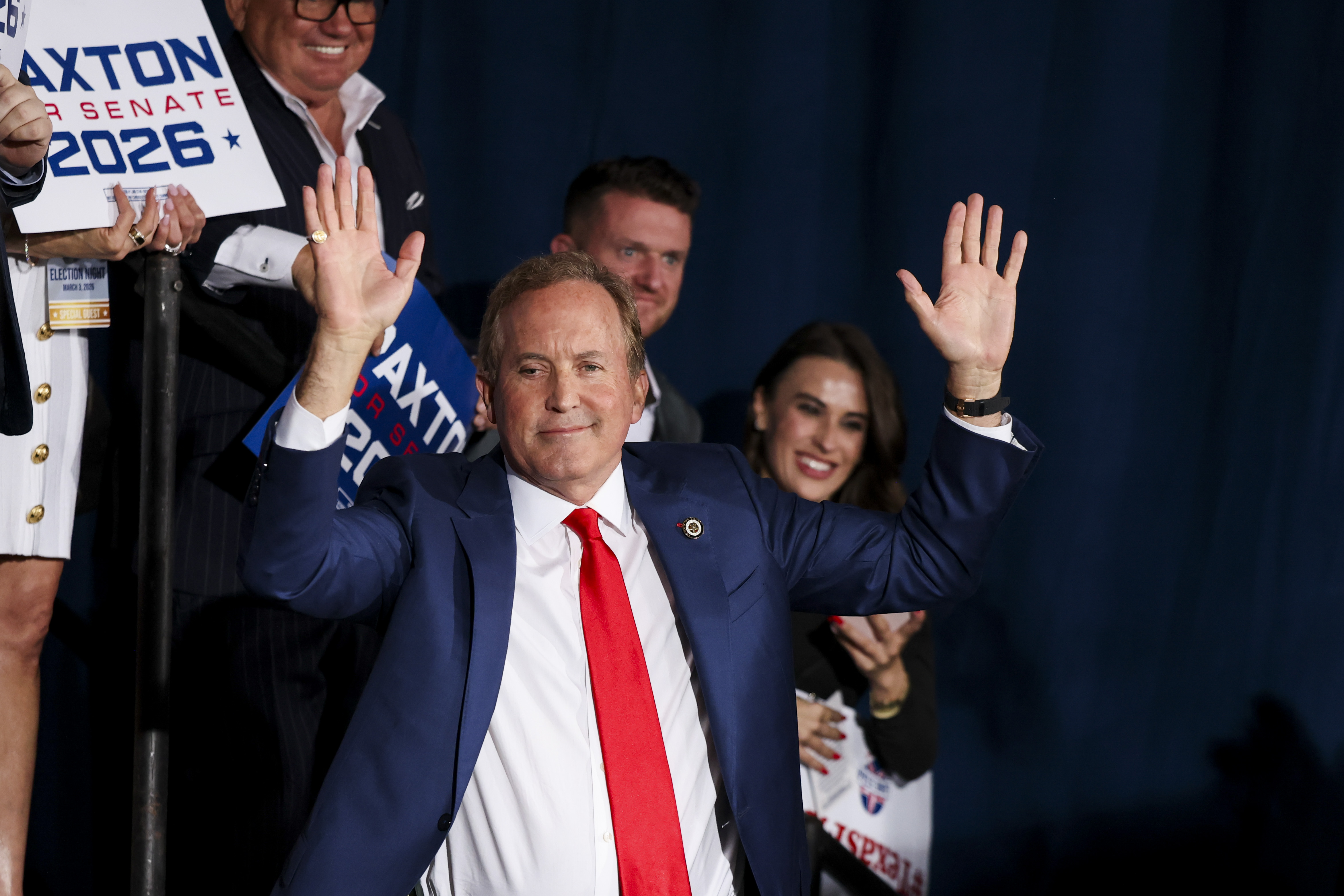
In June, thousands of Republicans gathered in Houston beneath a simple message displayed across the Texas GOP convention: “Unity Drives Victory.”
Gov. Greg Abbott made the argument plainly. “When Republicans unite, we are unbeatable,” he told delegates. After years of internal conflict, bitter primaries and disputes over the direction of their party, Republican leaders had decided it was time to put their differences aside.
On November 3, Texas voters delivered an answer.
James Talarico defeated Ken Paxton for the United States Senate. Gina Hinojosa defeated Abbott. Democrats swept the remaining statewide executive contests and broke a Republican winning streak that had lasted more than three decades.
It was a remarkable rejection of a party that had dominated Texas politics for a generation. And it raises an uncomfortable question about the Republican Party's approach to one of its most controversial nominees.
What happens when a party achieves unity among its leaders without resolving the concerns of its voters?
The Difference Between Loyalty and Accountability
Three years before Texas Republicans rallied behind Paxton for the Senate, their own lawmakers had voted overwhelmingly to impeach him.
On May 27, 2023, the Texas House adopted 20 articles of impeachment alleging misconduct that included abuse of office, bribery and obstruction of justice. The vote was 121–23, with 60 Republicans joining 61 Democrats in support.
This was no ordinary partisan attack from the opposition. A substantial portion of Paxton's own party believed the allegations warranted a trial.
The Texas Senate subsequently acquitted him on all 16 articles considered at trial, and four additional articles were dismissed. Paxton denied wrongdoing, while his supporters argued that the impeachment represented an effort by political opponents to remove a conservative official whom voters had repeatedly elected.
Those distinctions matter. Impeachment was not a criminal conviction, and the Senate's acquittal was a consequential outcome. But the proceedings also exposed profound disagreements within the Republican Party about the conduct expected of its public officials.
Those disagreements did not disappear when Paxton defeated incumbent Sen. John Cornyn in the 2026 Republican primary runoff.
Yet the party's political response was to move toward unity.
Consider Republican state Reps. Matt Shaheen and Jeff Leach, both of whom supported Paxton's impeachment in 2023 and backed Cornyn during the 2026 primary. After Paxton became the nominee, both publicly committed to supporting him in the general election.
There is nothing inherently inconsistent about believing allegations deserve a trial and later supporting an acquitted candidate against a political opponent. Nor is it unreasonable for Republicans to believe that policy differences with Democrats outweigh their concerns about a particular Republican nominee.
Political parties exist, in part, to organize people who disagree about individual questions around a common governing agenda.
But that creates a responsibility to explain the compromises being made.
If a public official once considered allegations serious enough to justify impeachment, voters are entitled to ask what changed. Was the concern resolved by the Senate trial? Did the official reconsider the evidence? Or did the political calculation simply change when Paxton won the nomination?
Those are different answers, and voters have every right to evaluate them differently.
A party nomination settles who represents the party on the ballot.
It does not settle every question about that person's fitness for office.
Two Different Rejections
The election results suggest Republicans faced two overlapping problems.
One was Ken Paxton himself.
According to the Texas Secretary of State's November 4 unofficial returns, Paxton received 4,249,373 votes, compared with 4,524,527 for Abbott.
That is a difference of 275,154 votes between two Republican candidates appearing on the same statewide ballot.
It would be inaccurate to describe all 275,154 as voters who supported Abbott but rejected Paxton. Different races attract different numbers of votes, and some voters supported third-party candidates or left contests blank.
Nevertheless, the gap establishes that Paxton performed substantially worse than the Republican governor.
The historical comparison is even more revealing.
In 2022, Abbott received approximately 55.5% of the two-party vote in his race for governor. In 2026, his share fell to approximately 46.4%, a decline of 9.2 percentage points.
Paxton received approximately 55% of the two-party vote in his 2022 attorney general race. In his 2026 Senate race, that fell to 43.8%, a decline of 11.2 points.
The comparison is imperfect. Paxton was seeking a different office, facing a different opponent, and running in a different political environment. Four years also separate two electorates whose composition and concerns may have changed substantially.
But the distinction remains important.
Abbott's performance demonstrates a broad decline in Republican support. Paxton experienced additional weakness beyond that already difficult environment.
Put another way, the election presents two questions.
How many voters decided that Paxton was too much?
And how many had concluded that the Republican ticket itself was too much?
Those are different judgments, even when they produce the same outcome for a candidate.
The danger is assuming that the first caused the second simply because both occurred in the same election.
Bell County's Evidence
Bell County offers a particularly useful illustration of how voters separated their choices.
Abbott narrowly carried the county, receiving 54,723 votes to Hinojosa's 54,047.
In the Senate race, however, Talarico defeated Paxton by 5,675 votes.
The Directory's earlier precinct analysis established that at least 181 Bell County voters must have supported both Abbott and Talarico. That figure represents a mathematical minimum, rather than an estimate of the total number of split-ticket voters.
The local legislative contests provide another distinction.
Republican state Rep. Brad Buckley won reelection in House District 54, receiving 2,839 more votes than Paxton within the same 36 precincts.
Buckley had supported Paxton's impeachment in 2023. His victory does not establish that voters rewarded that decision, particularly because his own Republican vote share declined from 2024.
But his performance demonstrates that voters were capable of supporting a Republican candidate while withholding support from the party's Senate nominee.
These results are difficult to reconcile with the idea that every Republican candidate faced precisely the same electoral judgment.
They are equally insufficient to establish that Paxton's controversies caused other Republicans to lose.
Our preliminary comparisons of Republican House candidates have not demonstrated a reliable electoral advantage for those who supported impeachment over those who opposed it. Public support for Paxton in 2026 likewise has not produced a consistent, measurable penalty in the races examined.
That matters because the most tempting explanation of an election is not necessarily the one best supported by its results.
What the Voters Said
There is evidence that corruption was an important concern for Texas voters.
In the 2026 Texas voter survey published by ABC News, 55% of respondents said government corruption was crucial to their vote for Congress. Among those respondents, Talarico led Paxton 63% to 36%.
That is a substantial association between the importance voters assigned to corruption and their preference in the Senate race.
It is not proof that every respondent was thinking about Paxton's controversies. Government corruption encompasses far more than one official, and the survey question concerned voters' congressional choices.
The broader political environment also deserves serious consideration.
The same survey found that approximately 41% of respondents identified opposition to President Donald Trump as one reason for their U.S. House vote. Many Texans were weighing the economy, affordability, national leadership, government performance and issues that extended well beyond Paxton.
Republicans lost races in which Paxton was nowhere on the ballot.
A substantial portion of the party's difficulties may have been unavoidable given the national and statewide environment. Even a less controversial Senate nominee might have struggled.
We cannot know from election returns alone how many Republican-leaning voters stayed home because of Paxton, how many crossed party lines because of him, or how many rejected Republicans for reasons entirely unrelated to his candidacy.
But the uncertainty cuts both ways.
The absence of a precise causal measurement does not mean voters' concerns about character and accountability were politically irrelevant. It means we should be careful about assigning them a share of the defeat that the evidence cannot establish.
The question worth asking is whether the party's insistence on unity helped persuade skeptical voters—or merely discouraged its leaders from confronting their skepticism.
When Winning the Primary Becomes the Argument
There is a deeper institutional problem here.
Political primaries determine party nominees. They do not guarantee that the nominee represents the preferences of the entire electorate, or even every voter who regularly supports that party.
Paxton won the Republican nomination. His supporters had good reason to expect their party's leaders to recognize that result.
But the general election presented an entirely different electorate with a much broader set of priorities.
For years, Texas Republicans enjoyed a political advantage substantial enough to survive internal disputes, controversial nominees and disagreements over the direction of the party.
That success may have encouraged a belief that the most important political battle was the one fought inside the Republican primary.
Win the nomination, unite the activists, bring the establishment into line, and the general election would follow.
For much of modern Texas political history, that formula worked.
In 2026, it did not.
And perhaps the most consequential mistake would be treating that failure as evidence that the party simply needed to be more unified.
Unity can be valuable. A political party incapable of organizing its members around common goals will struggle to govern effectively. Every successful coalition requires compromise, and no candidate will satisfy every voter on every question.
But compromise has a cost, and political leaders have an obligation to recognize it.
When elected officials move from questioning a colleague's conduct to defending that colleague's candidacy, voters deserve a substantive explanation. Asking the public to put aside concerns simply because an election is approaching may work among committed activists. It is a much less persuasive argument to independents, moderates and voters whose support must be earned rather than assumed.
More importantly, accountability cannot depend entirely on which party holds power.
A standard that applies only to political opponents is not much of a standard.
That principle is larger than Ken Paxton, and it applies just as readily to Democrats confronting allegations against their own leaders.
Party loyalty can be a legitimate political consideration. It should never become the only one.
The Price of Unity
The Republican Party will spend the coming months examining what went wrong in 2026.
There will be arguments over nominees, campaign spending, turnout, the economy, Donald Trump and the direction of the conservative movement. Some Republicans will blame their leadership. Others will argue that the party moved too far in one direction or failed to communicate its priorities effectively.
Even before all the votes had been counted, the unity Republicans celebrated in Houston was giving way to public recriminations.
At his election-night gathering, defeated Republican Comptroller Don Huffines blamed Gov. Greg Abbott, Lt. Gov. Dan Patrick and the party's establishment for the losses. He argued that Republicans had failed to deliver on promises such as property-tax relief and had exhausted voters' patience after years in power.
Huffines was not calling for moderation. He blamed what he considered the party's compromising establishment, arguing that Republican leaders had abandoned the principles they claimed to represent.
The following morning, outgoing U.S. Sen. John Cornyn offered a considerably different assessment.
Writing in The Wall Street Journal, Cornyn argued that Republicans had forgotten the basic principles of building a successful political coalition. He criticized candidates who drove away potential supporters and party leaders who expected voters to overlook questions of personal character in the name of political loyalty.
His fourth principle was particularly pointed: character and integrity still matter.
Cornyn had warned throughout the Republican primary that nominating Paxton could jeopardize the party's longstanding dominance in Texas. After losing that contest, he continued to express reservations about Paxton's candidacy while maintaining his opposition to Democratic policies.
Now, in the aftermath of the election, Cornyn argued that Republicans had made voters choose between their policy preferences and their concerns about the people representing those policies.
Huffines blamed a Republican establishment that had failed to govern according to its promises. Cornyn blamed, among other things, a party increasingly willing to excuse the conduct of its own nominees.
Their explanations were not interchangeable, and neither establishes why the electorate voted as it did.
But the contrast reveals something the convention's message could not: beneath the appearance of unity, Republicans remained divided over what their party stood for, whom it represented and what standards its candidates should be expected to meet.
Those disagreements were still there when the party lost. The difference was that Republicans could no longer rely on winning in November to put them aside.
All are questions worth examining, and more than one explanation may ultimately be correct.
But party leaders should resist the temptation to explain away Paxton's individual underperformance as merely another consequence of a difficult election.
The returns show that some Texans who were willing to support Republicans elsewhere on the ballot were unwilling to support him.
They also show that Republican dissatisfaction extended far beyond his race.
What remains unanswered is whether the party's handling of Paxton contributed to that broader dissatisfaction, and whether the pressure to close ranks made it harder for Republicans to recognize how much public confidence they had lost.
The election may never provide a precise answer to that question.
It has already provided a reason to ask it.
Republicans had the right to nominate Ken Paxton. Their leaders had the right to support him. Voters had an equal right to examine his record, consider the party's defense of him and reach a different conclusion.
The mistake was assuming that unity among the first two groups would secure the approval of the third.
In Houston, the message was simple: Unity Drives Victory.
In November, Texas voters demonstrated that unity alone was not enough.
A political party can settle its disagreements internally. It cannot declare the public's questions settled with them.