
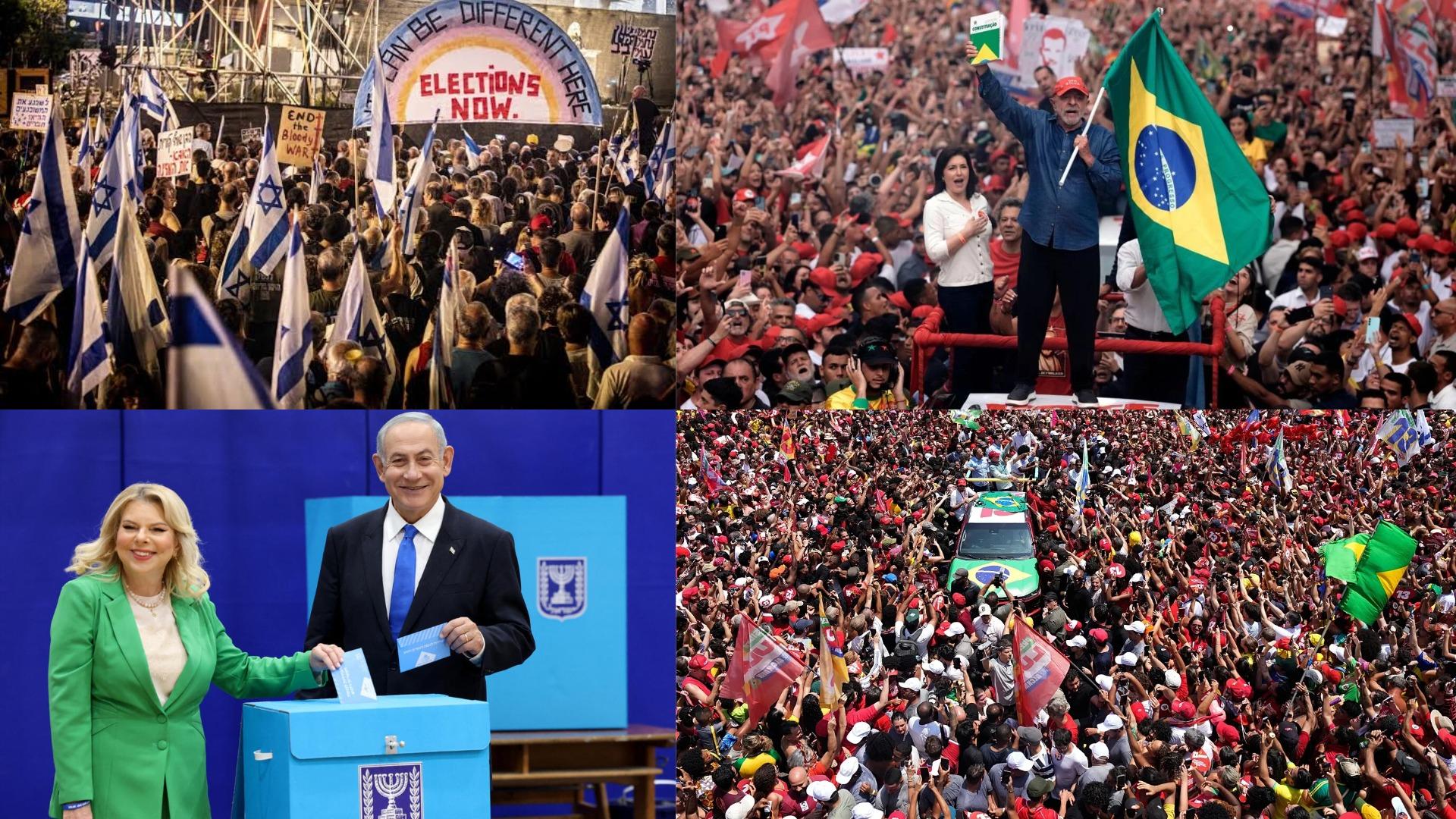
Brazil has a declared presidential winner and a disputed election-day decision. Israel has a deeply divided electorate and no clear governing majority. Both show why counting votes and resolving political conflict are different tasks.
Within three days, voters in Brazil and Israel delivered two very different outcomes.
Brazil reelected President Luiz Inácio Lula da Silva after he finished second in the first round. His defeated opponent, Flávio Bolsonaro, rejected the result, while controversy over an election-day court order raised legitimate questions about how a last-minute change was implemented.
Israel produced a different uncertainty. Voters turned out in their highest proportion since 1999, but preliminary results left neither Prime Minister Benjamin Netanyahu’s bloc nor its principal opponents with a parliamentary majority.
Brazil’s electoral authorities have announced who won. Israel is still determining who can govern.
Neither election closely resembles the American midterms on November 3. But both illustrate something worth remembering before Americans cast their remaining ballots: an election can produce a result without settling the political arguments surrounding it.
The responsibility is to distinguish those arguments—and the evidence each requires.
Brazil: A First-Round Lead Reversed
On October 4, Flávio Bolsonaro, a senator and son of former President Jair Bolsonaro, received 47.03% of Brazil’s valid presidential votes. Lula finished behind him with 45.16%.
Three weeks later, the positions reversed.
Brazil’s Superior Electoral Court announced that Lula won the October 25 runoff with 64,256,232 votes, or 51.79%. Bolsonaro received 59,826,041, or 48.21%.
The margin was approximately 4.43 million votes.
Lula became the first presidential candidate since direct elections resumed in 1989 to win after finishing second in the opening round. But the reversal was not simply a rematch between two unchanged electorates.
First-round supporters of eliminated candidates had another choice to make. Some voters who had abstained returned. Others could move from a blank or invalid ballot to a candidate.
The Carter Center reported that participation increased by almost 3 million votes between rounds. Electoral authorities put runoff participation at approximately 128.2 million voters, with abstention falling from 21.08% in the first round to about 19.2%.
That was a substantial change. It is not, by itself, evidence of an improper one.
National totals cannot tell us precisely how many people switched candidates, returned after abstaining or moved from an invalid ballot to a valid selection. An unusual outcome requires explanation. It does not establish manipulation.
The more consequential procedural controversy occurred as voting was supposed to end.
An Extension That Arrived After Closing Time
Both campaigns sought additional voting time.
Lula’s campaign raised transportation problems, including in Bahia. Bolsonaro’s campaign sought extensions in municipalities affected by severe rain and other disruptions.
The requests shared a basic concern: some people were having difficulty reaching the polls.
The response created another problem.
Supreme Court Justice Cristiano Zanin issued an emergency order extending voting until 7 p.m., Brasília time, after the scheduled 5 p.m. close. Brazil’s electoral court subsequently explained that thousands of electronic voting machines had already been closed and could not be reopened.
The extension therefore applied to polling stations still operating. Stations that had completed their shutdown remained closed.
That distinction deserves scrutiny.
Two voters encountering similar delays could have faced different opportunities depending on whether their polling place was still operating when the order took effect. The question is not merely whether additional time was justified. It is whether a nationwide extension could be implemented consistently after the original deadline had passed.
The electoral court’s president, Kassio Nunes Marques, acknowledged the operational difficulties. In the court’s published account, he described adjustments to vote transmission and counting procedures and warned about the consequences of changing voting hours so late.
Zanin’s background also made the decision politically contentious. He previously represented Lula in corruption proceedings before Lula appointed him to the Supreme Court in 2023.
That relationship is relevant context. It does not establish improper conduct. The decision’s legal basis and implementation still have to be examined on their merits.
What the Late-Ballot Count Establishes
On October 27, the electoral court reported 34,393 ballots recorded after 5 p.m., most during the following hour.
That is far smaller than Lula’s 4.43-million-vote margin. Even assigning every one of those ballots to Lula would not account for his victory.
There is an additional qualification: ballots cast after 5 p.m. were not necessarily ballots made possible by the extension. Under ordinary procedures, voters already waiting at the deadline were entitled to finish voting.
The court’s count therefore should not be described as 34,393 additional votes created by Zanin’s order.
Nor does it measure everyone who might have attempted to vote at a location that had already closed. Assessing that question would require evidence about affected locations, voter access and the scale of any resulting exclusion.
These are different claims: ballots actually recorded after the deadline, people potentially denied an opportunity to vote, and an allegation that the declared winner should not have won.
One cannot simply stand in for another.
A Declared Winner, a Continuing Dispute
Bolsonaro has called for the result to be annulled. His Liberal Party has taken a different position, acknowledging Lula’s victory while saying questions about the election should be clarified.
The Carter Center’s assessment also requires reading beyond a headline.
Its four-person expert mission commended the electoral court’s administration and the rapid production of results. It also criticized inconsistent or contradictory judicial decisions, identifying the voting-hours extension as a prominent example.
The mission focused on the legal framework, voting technology and voter education. It explicitly said it had not assessed the conduct of voting comprehensively and would not issue a comprehensive assessment of the entire election process.
Its statement supports neither dismissing every procedural criticism nor claiming observers uncovered a result-changing failure.
The aftermath became more complicated Wednesday when Bolsonaro arrived in Miami. Reuters reported that he had not complied with a Supreme Court order to surrender his passports to federal police the previous day.
His departure and the investigations surrounding him are separate from the evidentiary question presented by his election challenge. Neither establishes whether the vote was manipulated.
Brazil’s immediate lesson is the importance of distinguishing an unusual outcome, a flawed procedure and an incorrect result.
Those are three different propositions. Each requires its own evidence.
Israel: More Participation, No Clear Majority
Israel’s October 27 election produced a different problem.
Turnout reached 77.7%, the highest since 1999, according to the election committee figures reported by major news organizations. It was the first national election since the Hamas-led October 7, 2023, attacks and the wars that followed.
The turnout was decisive in scale. The parliamentary outcome was not.
With roughly 86% of ballots counted Wednesday morning, Israeli broadcasters projected 53 seats for Netanyahu’s bloc, 48 for the opposition bloc led by former military chief Gadi Eisenkot and 19 for Arab-led parties.
Those figures were preliminary. Later Wednesday reporting differed on the opposition tally, underscoring that neither bloc totals nor seat allocations should yet be treated as final.
The governing problem, however, was already apparent.
Israel’s 120-member Knesset is elected through national proportional representation. A governing majority ordinarily rests on the support of at least 61 lawmakers. Neither Netanyahu’s bloc nor Eisenkot’s principal opposition partners approached that number on their own.
Netanyahu could remain prime minister in a caretaker capacity even without securing a new majority. Losing a governing majority and being replaced are not the same event.
Arab Representation and the Coalition Barrier
The projected strength of Arab-led parties was one of the election’s most consequential developments.
Their potential 19 seats gave them substantial numerical influence. But seats that can be added on paper do not automatically produce a coalition.
Reuters reported that Eisenkot’s opposition would need broad Arab-party backing to displace Netanyahu, an arrangement rejected by many Jewish political leaders.
Arab parties also are not a single interchangeable bloc. Ra’am participated in the coalition that previously removed Netanyahu from office. Building an arrangement requiring the Joint List’s support presents a different political challenge.
The issue is therefore both electoral and institutional: representation can increase without producing agreement about who may legitimately participate in government.
It is also important to distinguish citizenship from territorial control. Arab citizens of Israel participate in Knesset elections. Palestinians in the West Bank and Gaza generally do not possess Israeli citizenship and do not vote in those elections.
The influence of Arab citizens inside Israel’s electoral system does not settle the separate disputes over occupation, Palestinian self-determination or political rights in those territories.
Neither should those disputes obscure the consequential role Arab voters played in this election.
A Different Leader Would Not Necessarily Mean Opposite Policies
American descriptions of Israel’s election can make the alternatives sound more straightforward than they are.
Eisenkot has sharply criticized Netanyahu and offers different political alliances and leadership. But he does not represent a wholesale reversal of Israel’s prevailing security position.
Reuters’ reporting before the election identified important overlap: both men oppose Palestinian statehood under their stated positions, insist Hamas must be disarmed before Israeli withdrawal from Gaza and express willingness to resume fighting.
Their differences remain consequential. Reuters identified disagreements involving settlement policy, unauthorized outposts and settler violence. Political alliances and the influence of Netanyahu’s far-right partners also matter.
Replacing a prime minister can change how decisions are made, which partners possess leverage and what domestic priorities receive attention—even when some security objectives remain similar.
Conversely, retaining Netanyahu would not establish that voters endorsed every action of his previous coalition.
For now, Israel faces negotiations without an obvious majority. The count will determine the parliamentary balance. Political decisions will determine whether that balance can support a government.
America’s Different Election, a Familiar Responsibility
Americans will not choose a president on November 3. They will choose members of Congress and decide state and local contests under systems unlike Brazil’s presidential runoff or Israel’s parliamentary coalition process.
Neither foreign election supplies a reliable prediction for the American result.
They do supply useful distinctions.
Brazil demonstrates why procedural consistency matters—and why criticism of a procedure must be separated from evidence that it changed the winner.
Israel demonstrates why turnout and representation do not necessarily resolve the question of governing authority. A party can lose its majority without its opponents assembling an alternative.
Here in Bell County, voters are deciding their representation, local spending and the powers of public institutions. Those decisions deserve scrutiny before the ballots are cast and accountability afterward.
The task is neither to accept every challenge as proof of wrongdoing nor dismiss every concern because a winner has been announced.
It is to establish what happened, identify what remains uncertain and require evidence proportionate to the claim.
The vote determines who receives authority. It does not end the obligation to explain how that authority is used.